Restoring trust through reciprocity.
Ayni helps communities practice reciprocity as a way of life: asking without shame, gifting beyond transaction, and caring for one another in a living web of trust and mutual support.
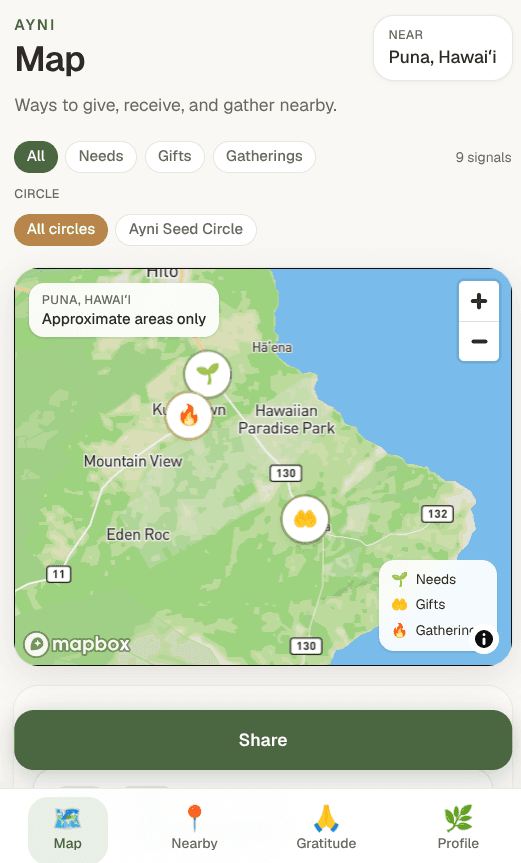
Our first tool is a living map where communities can make needs, gifts, gatherings, and gratitude visible; this allows acts of care to be seen, remembered, and woven into the community.
Currently being piloted through a Seed Circle in Puna, Hawaiʻi.
Many of us are connected, yet unsupported.
We can reach one another instantly, yet many of us still feel alone in the moments when support matters most.
All of us carry gifts that long to be shared, but we may not know where those gifts are needed or how to share them. All of us also carry needs, but asking for support can bring up shame, uncertainty, or fear of becoming a burden.
At the same time, many of our systems teach us to relate through transaction: What is this worth? What do I get back? Who owes whom? Even when we long to give, we may hold back, unsure whether support will be there when our own needs arise.
What if generosity could flow again, not as charity, obligation, or direct repayment, but as part of a living web of relationship?
A living culture of mutual support.
Ayni envisions communities where needs can be named with dignity, gifts can be offered freely, and each act of care strengthens the whole.
In this way of living, giving is not charity. Receiving is not dependency. Support is not a transaction to settle.
Reciprocity does not require balance to return through the same person. Someone may help you today; tomorrow, you may help someone else. A neighbor may support a family. A family may support a land project. A project may nourish the wider community.
Over time, care circulates through the whole web, not as debt or obligation, but as trust, gratitude, and relationship.
Ayni exists to make this kind of reciprocity easier to practice in everyday community life.
An ancient principle, practiced anew.
Ayni is a word and principle carried through the Andean world, especially among Quechua/Kichwa and Aymara peoples, where reciprocity is understood not only as exchange, but as a sacred pattern of life.
It reminds us that we do not live as isolated individuals, but within a web of relationship with one another, with the land, with ancestors, and with future generations.
This project is inspired by that wisdom, and by many cultures around the world that have remembered life as relationship rather than transaction. We use the word with humility, gratitude, and a commitment to continuously learn the practice of reciprocity.
How it works: from visibility to support.
Ayni helps make the invisible life of a community visible: where care is needed, where abundance already exists, and where people are coming together. As the network grows, Ayni can also help meaningful connections surface, so needs and gifts can find one another more easily.
Circles
Spaces of belonging, trust, and shared context: neighborhoods, land projects, parenting groups, friend networks, mutual support circles, and local communities.
Needs
Requests for support: childcare, illness support, project materials, advice, help repairing a fence, or volunteers for a planting day.
Gifts
Skills, resources, capacities, and offerings people are happy to share, helping abundance become visible beyond job titles or economic roles.
Gatherings
Moments when people come together to strengthen relationship, share skills, care for land, offer support, celebrate, listen, or serve.
Gratitude
How generosity becomes remembered. Gratitude helps acts of care be seen, honored, and woven into the life of the community.
Connections
Over time, Ayni can help surface meaningful connections between needs, gifts, and gatherings, so support can find its way more naturally.
Trust has a memory.
Ayni is not a system for tracking debt, ranking generosity, or enforcing repayment. It helps communities remember care through visible participation, gratitude, and trust.
Ways in
Share a need
Name where support would be welcome.
Offer a gift
Share what you are happy to give.
Create or join a gathering
Come together to strengthen relationship.
Care becomes visible
Needs, gifts, gatherings, and gratitude help people see where support is needed, where abundance is present, and who is showing up for the community.
Support flows
Gratitude honors care
Trust grows
Over time, visible acts of care help communities remember where generosity is flowing, how relationships are growing, and where stewardship is taking root.
This is how reciprocity becomes more than a single exchange: support can return through the wider web, not as debt or obligation, but as relationship.
Beginning small, so the roots can grow strong.
Ayni is currently being built and tested through a few small, invitation-based Seed Circles in Puna, Hawaiʻi. These early circles are not a full public launch. They are living pilots with people who share enough trust, context, and curiosity to help test whether the core reciprocity loop can become real.
We are beginning with circles rooted in regenerative exchange, parent support, and land-based community.
The first question is simple: Can small communities make needs, gifts, gatherings, support, and gratitude visible enough that reciprocity starts flowing more naturally?
The goal is not scale yet. The goal is aliveness.
We are looking for real needs, real gifts, real support, real gratitude, and honest learning.
- Supporting small circles of trusted early participants
- Making needs, gifts, gatherings, support, and gratitude visible
- Testing whether asking and offering feel more natural than in a group chat
- Learning what makes the experience feel dignified, relational, and useful
- Keeping the first vessels small enough to hold with care
Ayni is for those practicing another way.
- Neighbors, families, parents, elders, and caregivers who want support to feel more natural and direct
- People with gifts they long to share, and people with needs they are learning to name
- Groups stewarding something together: land, art, or other shared projects
- Networks and organizations helping care, resources, and belonging move through community
- Communities building trust, resilience, and mutual support in uncertain times
- Anyone who longs for a less transactional way to live
Ayni begins locally, with relationships close enough to touch. Over time, it can also help communities learn from, support, and inspire one another across places.
The spirit we are practicing.
Reciprocity
We practice giving and receiving as part of a living field of mutual care beyond transaction.
Belonging
We strengthen the fabric of community by making needs welcome, gifts visible, trust embodied, and support dignified.
Stewardship
We care for land, community, culture, and future generations through gifts in service of life.
Why I’m building Ayni
Ayni began from a pattern I kept encountering in life: so much abundance around us, and yet so many needs and gifts remaining unseen.
Living in Puna, Hawaiʻi, and helping steward land and community, I have witnessed how many beautiful gifts people carry: food, tools, skills, care, wisdom, labor, creativity, and love. I have also seen and experienced how vulnerable it can feel to ask for help, and how much trust it takes to offer our gifts freely.
Ayni is my attempt to build a small, practical vessel for remembering something ancient: that we belong to one another, and that support can move through relationship rather than transaction.
We are beginning small, with a few trusted circles, so we can listen carefully and learn whether this tool helps reciprocity become more visible, safe, and alive.
Connect with Ayni
We would love to hear from you.
Whether you are curious about joining a Seed Circle, exploring partnership, supporting the work, offering feedback, or simply learning more, you are welcome to reach out.
Share a little about who you are, what you are curious about, and what kind of connection would feel meaningful.